Triple-Negative
Breast Cancer
Images do not represent real patients.
What is Triple-Negative Breast Cancer?
Triple-Negative Breast Cancer is a unique form of breast cancer.1 Breast cancer is when abnormal cells in the breast begin to grow and divide in an uncontrolled way, and eventually form a growth (tumour).2
Once breast cancer has been diagnosed, the cancer cells are checked for certain features.
Triple-Negative Breast Cancer does not have these features that are found in other breast cancers:3
- It does not have estrogen and progesterone hormone receptors
- It does not have too much of a protein called Human Epidermal Growth Factor Receptor2 (HER2)
The Breast
Anatomy of the breast2
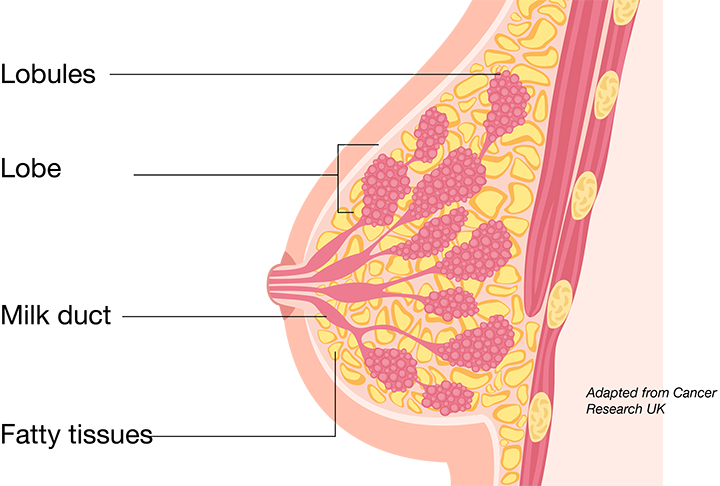
Breasts are made up of:2
- Fat
- Glandular tissue divided into lobes (each containing lots of lobules)
- A network of ducts or milk ducts
- Connective tissue
The lobules produce milk for breastfeeding and connect to the ducts. The ducts spread from the lobes towards the nipple.
In most cases, breast cancer starts in the cells that line the milk ducts of the breast.2 Triple-Negative Breast Cancer is a type of invasive breast cancer, which means that cancer cells have spread outside the ducts where they started and into the surrounding breast tissue.2,3
Who is at risk?
Anyone can get Triple-Negative Breast Cancer, but certain factors can increase a person’s risk. This type of breast cancer is more common in women who:3
- Are younger than 40
- Are of African descent, or
- Have a mutation (change) in the Breast Cancer Gene1 (BRCA1)
- Genes are pieces of DNA inside each cell, that tell the cell how to make the proteins it needs to function4
- Cancer develops when certain genes in a cell become abnormal, causing the cell to grow and divide out of control4
- The BRCA1 gene normally helps stop cells from growing too much. When this gene has a fault (mutation), cells may grow out of control and raise the chance of getting Triple-Negative Breast Cancer3,5
Images do not represent real patients.
Symptoms
Symptoms of Triple-Negative Breast Cancer (all breast cancers) include:2

A lump, or thickening in your breast or armpit

A change in the size, shape, or feel of your breast

Skin changes in the breast, such as puckering, dimpling, a rash, or redness of the skin

Fluid leaking from the nipple, in a woman who is not pregnant or breastfeeding

Changes in the position of the nipple
Types of Breast Cancer
There are many different types of breast cancer. The type is determined by the specific kind of cells in the breast that are affected. Most breast cancers are carcinomas. The most common breast cancers such as ductal carcinoma in situ (DCIS) and invasive carcinoma are adenocarcinomas, since the cancers start in the gland cells in the milk ducts or the lobules (milk-producing glands). Other kinds of cancers can grow in the breast, like angiosarcoma or sarcoma, but are not considered breast cancer since they start in different cells of the breast.3
Breast cancers are also classified by certain types of proteins or genes each cancer might make. Breast cancer cells are tested for the following proteins or receptors on the cancer cells:3,6
- Estrogen Receptor (ER)
- Progesterone Receptor (PR)
- Human Epidermal Growth Factor Receptor2 (HER2)
The term Triple-Negative Breast Cancer refers to the fact that the cancer cells do not have estrogen or progesterone receptors and also do not have too much of the HER2 protein. The cells test “negative” on all 3 receptor tests. Triple-Negative Breast Cancer accounts for about 10-15% of all breast cancers.3
Because of its unique features, Triple-Negative Breast Cancer does not respond to some of the standard treatments for breast cancer, and so it requires a different treatment approach.3
Your oncologist and surgeon will use the type of breast cancer you have, to plan your treatment. The type shows which cells are affected – this helps choose the treatments that are most likely to work for you.8
Screening
Screening is looking for signs of breast cancer, before a person has symptoms. The goal of screening tests is to find the cancer at an early stage, when it can be treated and may be cured.7
A mammogram (a special x-ray to detect lumps in the breast), does not prevent breast cancer. It can save lives by finding breast cancer as early as possible. Women from the age of 40 should go for an annual mammogram. Women 55 years and older, should have a mammogram every two years – or if they choose to, continue with an annual mammogram.8
A regular monthly Breast Self-Examination (BSE) can play an important role in detecting breast cancer earlier, compared to noticing a lump by chance.8 This involves inspecting your breasts to check for changes, such as a lump, by looking at, and feeling your breasts, regularly.9 Although not every breast lump is cancerous, any lump should be checked by a doctor. Speak to your doctor, if you notice anything different or unusual about the look and feel of your breasts.8
If a screening test result is abnormal, you may need to have more tests done, to find out if you have cancer. These are called diagnostic tests, rather than screening tests.7
Diagnosis
Diagnosing breast cancer in general
Different tests can be used to look for and diagnose breast cancer. If your doctor finds an area of concern on a screening test (a mammogram), or if you have symptoms that could indicate breast cancer, you will need more tests to know for sure that it is cancer.3
A biopsy of the breast is a procedure done to remove a piece of breast tissue or tumour, called a sample. During a biopsy, a doctor takes samples from the suspicious area, so they can be looked at in the lab to see if they contain cancer cells.10 There are different ways of doing a biopsy. In general, pressure is placed on the breast, which can sometimes feel uncomfortable, but is not usually painful.11 A local anaesthetic may be given for certain biopsies to numb the area, while others may require deeper anaesthesia. Needing a breast biopsy does not necessarily mean you have cancer. Most biopsy results are not cancer, but a biopsy is the only way to find out for sure.10
Diagnosing Triple-Negative Breast Cancer
After breast cancer is diagnosed, the cancer cells will be checked for certain proteins. If the cancer cells do not have estrogen or progesterone receptors and also do not have too much of the HER2 protein, Triple-Negative Breast Cancer is diagnosed.3
Images do not represent real patients.
Stages of Breast Cancer12
A cancer stage describes the extent of cancer in the body, especially whether the cancer has spread from where it first formed to other parts of the body. It is important to know the stage of breast cancer in order for the oncologist and surgeon to plan the best way to treat it.3

Stage 112
This is the earliest stage of invasive breast cancer. Invasive means the cancer has grown, or spread into nearby or surrounding breast tissue.

Stage 212
The tumour may have grown up to 5 cm (about the size of a lime), or larger. Cancer may, or may not, start to appear in the lymph nodes.

Stage 312
The tumour may be larger than stage 2 and may have spread to lymph nodes, or tissue around the breast.

Stage 412
Cancer has spread beyond the breast and nearby lymph nodes to other parts of the body.
It is important to begin breast cancer treatment as soon as possible. Starting early helps stop the disease from progressing to a more advanced stage and gives you the best chance for successful treatment, long-term survival and a better quality of life.13
Treatment
Treatment is carefully tailored to suit each individual.14 Triple-Negative Breast Cancer will not respond to hormone therapy or HER2-targeted treatments, making it harder to treat.3
Treatment options for Triple-Negative Breast Cancer include:

Surgery
This is a procedure, in which a surgeon removes cancer from your body.15 Depending on the stage of breast cancer, surgery may involve removal of the lump and some of the surrounding tissue, or removal of the whole breast.16

Radiation Therapy
Radiation therapy (also called radiotherapy), is a cancer treatment that uses high-energy x-rays, to kill cancer cells and shrink tumours:15
- External beam radiation therapy comes from a machine that aims radiation at your cancer
-
Internal radiation therapy is a treatment in which a source of radiation is placed inside your body
B rachytherapy, is when seeds, ribbons, or capsules that contain a radiation source are placed in your body, in or near the tumour
Radiation therapy may be used after surgery, to destroy the remaining cancer cells. It can also be used to treat cancer that has spread.16

Chemotherapy
Chemotherapy (also called chemo), uses medicines to stop the growth of cancer cells, either by killing the cells, or by stopping them from dividing.15
Immunotherapy
This is a type of treatment that uses medicines, to help a person’s immune system better recognise and destroy cancer cells.17
Using Your Immune System to Fight Cancer with Immunotherapy
An important part of the immune system, is its ability to keep itself from attacking normal cells. To do this, it uses certain proteins on immune cells, called “checkpoints”, which act like switches that turn immune responses on or off. Cancer cells can sometimes use these proteins to hide from the immune system.3,17
Immunotherapy is medicines that help a person’s immune system fight cancer. By targeting the proteins on the immune cells, they can be used to treat certain types of breast cancer, including Triple-Negative Breast Cancer.3,17 Breast cancers are also classified by certain types of proteins or genes each cancer might make. Breast cancer cells are tested for the following proteins or receptors on the cancer cells:3,6
Follow-up Care During and After Treatment
As you go through treatment, you will have follow-up tests or check-ups. Some of the tests that were done to diagnose, or to find out the stage of the cancer, may be repeated to see how well the treatment is working. Decisions about whether to continue, change, or stop treatment, may be based on the results of these tests.18
These visits provide an opportunity for you to talk to your doctor about any symptoms, side effects, questions, or concerns that you may have.

Images do not represent real patients.
References: 1. National Cancer Institute. What is Cervical Cancer. 15 June 2023. Available from: https://www.cancer.gov/types/cervical. Accessed 24 September 2025. 2. National Comprehensive Cancer Network. NCCN Guidelines for Patients. Cervical Cancer. 2025. 3. American Cancer Society. Signs and symptoms of cervical cancer. 2 October 2024. Available from: https://www.cancer.org/cancer/types/cervical-cancer/detection-diagnosis-staging/signs-symptoms.html. Accessed 24 September 2025. 4. American Cancer Society. What is Cervical Cancer? 23 August 2023. Available from: https://www.cancer.org/cancer/types/cervical-cancer/about/what-is-cervical-cancer.html. Accessed 24 September 2025. 5. National Cancer Institute. Cervical Cancer Screening.
13 February 2025. Available from: https://www.cancer.gov/types/cervical/screening. Accessed 24 September 2025. 6. American Cancer Society. Can Cervical Cancer Be Found Early? Available from: https://www.cancer.org/cancer/types/cervical-cancer/detection-diagnosis-staging/detection.html. Accessed 24 September 2025. 7. American Cancer Society. Tests for Cervical Cancer 28 June 2024. Available from: https://www.cancer.org/cancer/types/cervical-cancer/detection-diagnosis-staging/how-diagnosed.html. Accessed 24 September 2025. 8. National Cancer Institute. Cervical Cancer Diagnosis. 01 March 2024. Available from: https://www.cancer.gov/types/cervical/diagnosis. Accessed 24 September 2025. 9. Johns Hopkins Medicine. Cervical Biopsy. Available from: https://www.hopkinsmedicine.org/health/treatment-tests-and-therapies/cervical-biopsy. Accessed 24 September 2025. 10. National Cancer Institute. Cervical Cancer Stages. 16 May 2025. Available from: https://www.cancer.gov/types/cervical/stages. Accessed 24 September 2025. 11. National Cancer Institute. Cervical Cancer Treatment. 03 April 2025. Available from: https://www.cancer.gov/types/cervical/treatment. Accessed 24 September 2025. 12. National Cancer Institute. Types of Cancer Treatment. Available from: https://www.cancer.gov/about-cancer/treatment/types/surgery. Accessed 24 September 2025. 13. National Cancer Institute. Radiation Therapy to Treat Cancer. 15 May 2025. Available from: https://www.cancer.gov/about-cancer/treatment/types/radiation-therapy. Accessed 24 September 2025. 14. American Cancer Society. Treating Cervical Cancer. Available from: https://www.cancer.org/cancer/types/cervical-cancer/treating.html. Accessed 24 September 2025. 15. American Cancer Society. Immunotherapy for Cervical Cancer. 01 July 2025. Available from: https://www.cancer.org/cancer/types/cervical-cancer/treating/immunotherapy.html. Accessed 24 September 2025.
ZA-NON-01074. Expiry date: 30/09/2027.