Endometrial
Cancer
Images do not represent real patients.
What is Endometrial Cancer?
Endometrial cancer is a type of cancer of the uterus (or womb). It starts when cells in the endometrium – the inner lining of the uterus – begin to grow out of control.1,2
The uterus (or womb) and endometrium
The female reproductive system is made up of the uterus (or womb), ovaries, fallopian tubes, cervix and vagina.1
Anatomy of the female reproductive system1
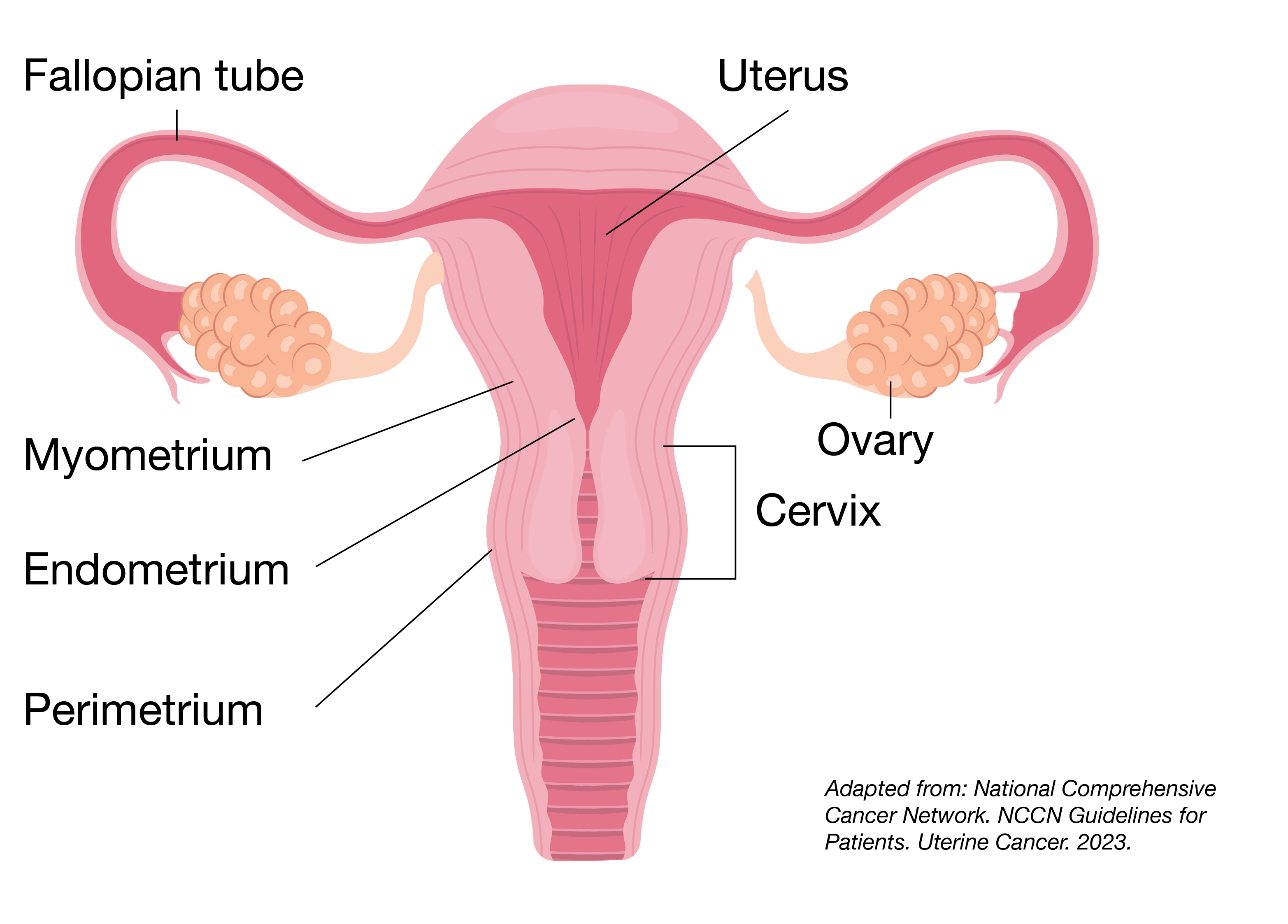
The uterus (or womb), is a hollow organ – roughly the size and shape of a medium-sized pear, where a developing baby grows during pregnancy.1,2 It has 3 main layers:1
- Endometrium: The thin inner lining of the uterus, which is a normal part of the reproductive system
- Myometrium: The thick, muscular middle layer
- Perimetrium (or Serosa): The thin, outer layer of the uterus
Endometrial cancer occurs, when the cells of the endometrium start growing in an abnormal and uncontrolled way.1,2
Symptoms
Certain symptoms may be signs of endometrial cancer.
The most common symptom is abnormal vaginal bleeding. This can include:4
- Changes in your usual period cycle
- Bleeding between periods
- Bleeding after menopause
For those who have gone through menopause, it is especially important to report any vaginal bleeding, spotting, or abnormal discharge to your doctor.4
Other possible symptoms include:4
- Pain, or a feeling of pressure in the pelvis (lower belly)
- Unexpected weight loss
These symptoms are more common in later stages of the disease. A delay in scheduling your doctor visit, could allow the disease to get worse and make treatments less effective.4
Keep in mind that abnormal bleeding can also be caused by conditions that are not cancer. It is important to speak to your doctor about any irregular bleeding.4

Types of Endometrial Cancer
Endometrial cancers can be divided into 2 types, depending on whether the cancer cells need the estrogen hormone to grow:2
- Type 1 endometrial cancers are the most common types that depend on estrogen for growth. They are most often endometrioid carcinomas
- Type 2 endometrial cancers do not depend on estrogen for growth
Endometrial cancer can be further divided into subtypes, grouped by how the cancer cells look under the microscope.
These include:2
- Endometrioid carcinoma (most common form of endometrial cancer)1
- Serous carcinoma
- Clear cell carcinoma
- Undifferentiated carcinoma/dedifferentiated carcinoma
- Mixed carcinoma
- Carcinosarcoma
- Rare/other endometrial carcinoma
Understanding the cancer type can help your oncologist determine the treatment that will work best for you.5
Screening
Screening is looking for cancer before a person has any symptoms. This can help find cancer at an early stage. When abnormal tissue or cancer is found early, it may be easier to treat.6
There is no standard or routine screening test for endometrial cancer.6
Diagnosis
To find out exactly what kind of endometrial change is present, the doctor must take out some tissue, so that it can be tested and looked at under a microscope. Endometrial tissue can be removed in different ways. An endometrial biopsy is the most commonly used test to diagnose endometrial cancer:7
- During this procedure, a very thin, flexible tube, is inserted into the uterus (or womb). A suction is then used to remove a small amount of the endometrium through the tube. This process takes about a minute or less. Some discomfort, similar to menstrual cramps, can be felt. Your doctor may suggest you take an anti-inflammatory medicine before the procedure. In some cases, a local anaesthetic is given to numb the area, to help reduce pain.
Images do not represent real people.
Stages of Endometrial Cancer
A cancer stage describes the extent of cancer in the body, especially whether the cancer has spread from where it first formed, to other parts of the body. The stage is one of the most important factors in deciding how to treat the cancer and determining how successful the treatment might be:8,9

Stage 1
The cancer is growing inside the uterus and/or is limited to the uterus and ovaries. The cancer has not spread to nearby lymph nodes, or to distant parts of the body.

Stage 2
The cancer has spread from the uterus and is growing into the cervix, or myometrium. The cancer has not spread to nearby lymph nodes, or to distant parts of the body.

Stage 3
The cancer has spread outside the uterus but has not spread beyond the pelvis to the inner lining of the rectum, or urinary bladder. The cancer spreads to certain lymph nodes, as this stage of cancer progresses but has not spread to distant parts of the body

Stage 4
The cancer has spread to the bladder, beyond the pelvis. It may involve nearby lymph nodes and organs, such as the stomach, or distant parts of the body, such as the kidney, lungs, liver, brain, and bone and lymph nodes. This is generally considered advanced endometrial cancer.
Treatment
Treatment is carefully tailored to suit each individual.10 There are different types of treatment for endometrial cancer:11

Surgery
This is a procedure, in which a surgeon removes cancer from your body.12 For endometrial cancer, it may involve removal of the uterus (or womb).11 Your doctor will have a discussion with you about whether surgery will be part of your treatment plan.

Hormone Therapy
A type of treatment that removes certain hormones, or blocks their action and stops cancer cells from growing.11
Radiotherapy
Radiation therapy (also called radiotherapy), is a cancer treatment that uses high-energy x-rays, to kill cancer cells and shrink tumours:14
- External beam radiation therapy comes from a machine that aims radiation at your cancer
- Internal radiation therapy is a treatment, in which a source of radiation is placed inside your body. Brachytherapy is when seeds, ribbons, or capsules that contain a radiation source are placed in your body, in or near the tumour.
The way the radiation therapy is given, depends on the type and stage of the cancer being treated. External and internal radiation therapy are used to treat endometrial cancer.11

Immunotherapy
This is a newer type of treatment that uses medicines, to help a person’s immune system better recognise and destroy cancer cells.1,13

Chemotherapy
Chemotherapy (also called chemo) uses medicines to stop the growth of cancer cells – either by killing the cells, or by stopping them from dividing.11

Targeted Therapy
This type of treatment uses medicines, to block the action of certain proteins or substances that cancer cells need, to grow and spread.12
If you have questions, ask your doctor, pharmacist, gynaecologist, nurse, or support group, to explain your treatment options.
Using Your Immune System to Fight Cancer with Immunotherapy
An important part of the immune system, is its ability to keep itself from attacking normal cells. To do this, it uses certain proteins on immune cells, called “checkpoints”, which act like switches that turn immune responses on or off. Cancer cells can sometimes use these proteins, to hide from the immune system.13
Immunotherapy is medicines that help a person’s immune system fight cancer. By targeting the proteins on the immune cells, they can be used to treat endometrial cancer.13
Follow-Up Care During and After Treatment
As you go through treatment, you will have follow-up tests or check-ups. Some of the tests that were done to diagnose endometrial cancer, or to find out the stage of the cancer, may be repeated to see how well the treatment is working. Decisions about whether to continue, change, or stop treatment, may be based on the results of these tests.11
Some of the tests will continue to be done from time to time after treatment has ended. The results of these tests can show if your condition has changed, or if the cancer has recurred (come back).11
These visits provide an opportunity for you to talk to your doctor about any symptoms, side effects, questions, or concerns that you may have.

Images do not represent real patients.
Download materials
New resources coming soon.
References: 1. National Comprehensive Cancer Network. NCCN Guidelines for Patients. Uterine Cancer. 2023. Available online at chrome-extension://efaidnbmnnnibpcajpcglclefindmkaj/https://www.nccn.org/patients/guidelines/content/PDF/uterine-patient.pdf. Accessed date: 24 September 2025. 2. American Cancer Society. What is Endometrial Cancer. 28 February 2025. Available from: https://www.cancer.org/cancer/types/endometrial-cancer/about/what-is-endometrial-cancer.html. Accessed date: 24 September 2025. 3. American Cancer Society. Endometrial Cancer Risk Factors. 28 February 2025. Available from: https://www.cancer.org/cancer/types/endometrial-cancer/causes-risks-prevention/risk-factors.html. Accessed date:
24 September 2025. 4. American Cancer Society. Signs and symptoms of endometrial cancer. 28 February 2025. Available from: https://www.cancer.org/cancer/types/endometrialcancer/detection-diagnosis-staging/signs-and-symptoms.html. Accessed date: 24 September 2025. 5. Cleveland Clinic. Uterine Cancer (Endometrial Cancer). 21 March 2023. Available from: https://my.clevelandclinic.org/health/diseases/16409-uterine-cancer. Accessed date: 24 September 2025. 6. National Cancer Institute. Endometrial Cancer Screening. 06 May 2025. Available from: https://www.cancer.gov/types/uterine/patient/endometrial-screening-pdq#_13. Accessed date: 24 September 2025. 7. American Cancer Society. Tests for Endometrial Cancer. Available from: https://www.cancer.org/cancer/types/endometrial-cancer/detection-diagnosis-staging/how-diagnosed.html. Accessed date: 24 September 2025. 8. American Cancer Society. Endometrial Cancer Stages.
8 February 2025. Available from: https://www.cancer.org/cancer/types/endometrial-cancer/detectiondiagnosis-staging/staging.html. Accessed 24 September 2025. 9. Berek JS, Matias-Guiu X, Creutzberg C, F et al. FIGO staging of endometrial cancer: 2023. Int J Gynaecol Obstet. 2023 Aug;162(2):383-394. 10. Cancer Research UK. Treatment for womb cancer. 22 February 2024. Available from: https://www.cancerresearchuk.org/about-cancer/womb-cancer/treatment. Accessed date: 24 September 2025 . 11. National Cancer Institute. Endometrial Cancer Treatment. 13 November 2020. Available from: https://www.cancer.gov/types/uterine/patient/endometrial-treatment-pdq#_131. Accessed 24 September 2025. 12. National Cancer Institute. Types of Cancer Treatment. Available from: https://www.cancer.gov/about-cancer/treatment/types. Accessed 24 September 2025. 13. American Cancer Society. Immunotherapy for Endometrial Cancer. 28 February 2025. Available from: https://www.cancer.org/cancer/types/endometrial-cancer/treating/immunotherapy.html. 14. National Cancer Institute. Radiation therapy to treat cancer. 2025. Available from: https://www.cancer.gov/about-cancer/treatment/types/radiation-therapy. Accessed date: 26 September 2025.
ZA-NON-01074. Expiry date: 30/09/2027.